How Solar Panels Work: What Every Homeowner Should Know
I am an Electrical Engineer with over 15 years of experience, including 6 years in solar installation. I currently work at MPUK, a $100M tech start-up. Having deployed solar systems across the country, I created this blog to provide clear, honest, engineer-grade advice, cutting through the marketing noise.
You drive past your neighbor's house and notice their roof is covered in solar panels. A few months later, their car is plugged in, the lights are on, and you overhear them say their electric bill is nearly zero. That scenario is playing out across the country, and it raises a fair question: does residential solar actually make sense for your home, or is it still something only the early adopters and the tech-obsessed bother with?
The honest answer is that solar panel technology has matured significantly. According to industry tracking data, the average installed cost per watt has fallen by more than 60 percent over the past decade, hardware reliability has improved substantially, and the installation process is more predictable than it was even five years ago. Typical payback periods now range from 7 to 15 years depending on location and electricity rates, a concrete financial track record that didn't exist for early adopters. This guide covers how the technology works, the types of panels available, what a full system includes, what it costs in 2026, and what installation actually looks like from start to finish.
How a solar panel turns sunlight into electricity
The photovoltaic effect, explained simply
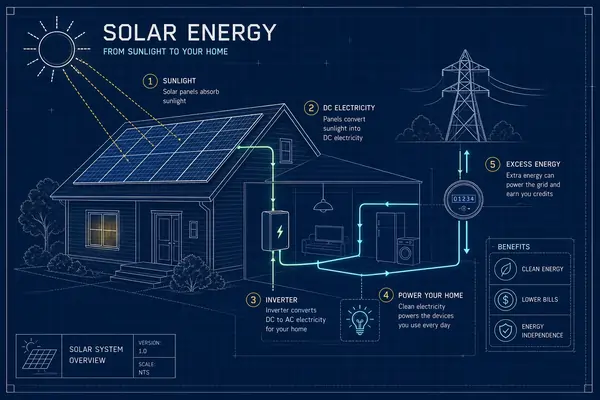
Solar panels are made of silicon cells. When photons from sunlight strike those cells, they knock electrons loose from their atoms, creating a flow of electrical charge. Think of it like a line of dominoes: the photon hits the first one, and the chain reaction produces a current. That current is direct current (DC), which flows in one direction, unlike the electricity your home already uses.
A single cell produces only a small amount of power, so solar PV panels are built with dozens of cells connected together. A typical residential installation then strings multiple panels together to produce meaningful output, usually between 6 kilowatts (kW) and 12 kW for an average American home. Most homes need between 15 and 22 panels to fully offset annual electricity consumption, depending on local sunlight and energy usage.
From rooftop to wall outlet: the DC-to-AC conversion chain
The DC electricity your panels generate is not what your appliances run on. Refrigerators, lights, and outlets all use alternating current (AC). An inverter sits between your panels and your home's electrical panel and handles that conversion. Without it, your panels are essentially useless to your household circuits.
Once converted, the electricity flows in one of three directions: it powers your home directly, charges a battery for later use, or feeds back into the utility grid if you are producing more than you need. Which path it takes depends on your system setup, the time of day, and your utility's net metering rules.
The main types of residential solar panels
Monocrystalline vs. polycrystalline: what the difference means for you
Monocrystalline panels are cut from a single silicon crystal, which allows electrons to move more freely. The result is higher efficiency, typically 15 to 23 percent, along with a cleaner all-black appearance that looks better on most roofs. Polycrystalline panels use fragmented silicon crystals, which creates more resistance for electrons and drops efficiency to 13 to 16 percent. They cost less per watt, but they take up more roof space for the same power output.
For most homeowners with a standard-sized roof, monocrystalline is the practical choice. If you have a large south-facing roof with minimal shading and you are working with a tighter budget, polycrystalline still gets the job done. The efficiency gap has widened enough, though, that monocrystalline panels now account for the overwhelming majority of residential installations, a shift driven by falling production costs and wider availability across panel brands. For a deeper technical comparison, see this monocrystalline vs polycrystalline solar panels breakdown.
Half-cut and bifacial panels: when the upgrade is worth it
Half-cut panels take each monocrystalline cell and slice it in two, which reduces internal resistance and keeps the panel cooler during operation. The performance gain is modest, roughly 1 to 2 percent over standard monocrystalline, but it adds up over a 25-year system life. Bifacial panels go further by capturing light from both the front and back surfaces, boosting total energy yield by 10 to 30 percent when conditions are right, particularly on light-colored roofs or ground-mounted systems.
Both technologies carry a modest price premium over standard monocrystalline. For a homeowner planning to own their system for decades, the long-term energy gain often justifies the extra upfront cost. Top brands like REC, Canadian Solar, and Hyundai now offer bifacial and half-cut solar modules with efficiencies reaching 22 to 22.5 percent in standard residential configurations, based on current manufacturer datasheets.
What a complete home solar system actually includes
Inverters, monitoring, and the hardware you don't see on the roof
Panels capture all the attention, but the inverter is the workhorse of any solar setup. String inverters connect all your panels in a series and are the most cost-effective option for unshaded roofs with simple layouts. Microinverters attach to each panel individually, which works better for roofs with partial shading or complex angles because one shaded panel does not drag down the output of the entire array. Hybrid inverters add battery compatibility for homeowners who want storage now or in the future.
Choosing the right inverter depends on your roof layout, your utility's interconnection requirements, and whether you plan to add a battery. Smart Home Authority's inverter buying guides break down these tradeoffs by system size and budget, including a side-by-side comparison of string vs. microinverter payback scenarios, and are a practical next step once you have a clear picture of your roof situation.
Solar batteries: do you need storage?
A solar battery stores the surplus energy your panels produce during daylight hours so you can use it at night or during a grid outage. Storage is not required for a grid-tied system, but it adds real value in states with time-of-use electricity rates, where drawing power from the grid during peak hours costs significantly more. Most residential systems pair with a 10 to 20 kWh battery, a range sized to cover a meaningful portion of the average American household's overnight consumption of 20 to 30 kWh.
If you want a full breakdown of home battery options, including chemistry comparisons between lithium iron phosphate and nickel manganese cobalt, Smart Home Authority's solar battery buying guide covers capacity sizing, pricing, and long-term performance across the most widely installed residential systems.
What residential solar costs in 2026
Solar panel cost per watt and total system pricing
The national average for a fully installed residential solar panel system in 2026 runs between $2.30 and $3.60 per watt before incentives, with a national average close to $2.82 per watt. A 6 kW system, which suits a typical home using 800 to 1,000 kWh per month, lands between $16,500 and $18,600. An 8 kW system runs $21,200 to $24,000. Regional labor costs, permit fees, and roof complexity push prices toward the higher end, with Arizona averaging $2.30 per watt and Massachusetts averaging $3.60 per watt.
The average American home needs a 6 to 8 kW system to achieve close to full offset, though that number shifts depending on how much electricity you use and how much direct sunlight your roof receives. Pull out your last 12 electricity bills and calculate your monthly average before you request any installer quotes.
Incentives available in 2026 and how they affect your net cost
The federal 30% Residential Clean Energy Credit expired for homeowner-purchased systems after December 31, 2025, barring new legislation. That is a significant change from prior years. For cash buyers, the upfront cost is now roughly 30 percent higher than it was in 2024, which pushes payback periods to 10 to 13 years nationally and up to 15 years in lower-electricity-rate states. In high-rate states like California and New York, payback periods can still run 7 to 9 years even without the federal credit.
Homeowners who lease rooftop solar panels or sign a power purchase agreement (PPA) can still access federal value indirectly, since the third-party system owner claims the credit and passes it through as lower monthly payments. State-level programs now carry more weight for direct buyers: Maryland offers grants, SREC sales, and property tax exemptions that can total over $10,000; New York offers a 25% state credit up to $5,000; California provides SGIP battery rebates up to $1,000 per kWh; and Austin Energy offers a $2,500 solar rebate. Check your state's specific programs before signing any contract, and consider using an online quote tool or incentive database to get a fast read on what applies to your address.
Understanding warranties and long-term performance
Product warranties vs. performance warranties: they are not the same thing
Premium residential solar panels in 2026 carry two separate warranties. The product warranty covers physical defects in materials and workmanship and now runs 25 years for top-tier brands, up from the 10 to 12 years that was standard on entry-level panels. The performance warranty guarantees a minimum power output over time, typically 25 to 30 years depending on the manufacturer.
Most premium panels guarantee at least 84 to 87 percent of nameplate output at year 25, while standard panels guarantee 80 percent. Qcells, for example, guarantees 86 percent output at year 25. Canadian Solar extends its performance warranty to 30 years. Maxeon takes it further, offering 40 years on both product and performance. Read both warranty documents carefully before committing to any panel, because a strong performance warranty attached to a weak product warranty leaves you exposed if hardware fails early. For a practical overview, consult this guide to solar panel warranties.
How much output to realistically expect over 25 years
Solar panels degrade gradually over time. The industry average is 0.5 to 1.0 percent per year, with a slightly larger drop of 2 to 3 percent in the first year as the cells stabilize. Premium panels using N-type TOPCon cells degrade at just 0.25 to 0.33 percent annually. By year 25, a quality panel retains 80 to 90 percent of its original output, which is still enough to cover most of a home's electricity needs.
Those numbers are not marketing language. Consider a system sized to cover 100 percent of your current usage: if that panel retains 84 percent capacity at year 25 and your household consumption stays roughly constant, it still covers more than four-fifths of your bill. That is why long-term performance guarantees from reputable manufacturers carry genuine financial weight.
What the installation process looks like from start to finish
Before any panel touches your roof
Installation starts well before any crew shows up. A site assessment covers your roof's age, orientation, shading patterns, structural capacity, and the capacity of your existing electrical panel. Your installer then files permits with your local authority having jurisdiction and submits interconnection paperwork to your utility company. This pre-work commonly takes 4 to 8 weeks depending on your municipality and utility backlog. A rushed or incomplete site assessment is the most common reason systems underperform after installation, so treat this stage as seriously as the panel selection itself.
Installation day and the steps that follow
The physical installation of a typical 20-panel system takes one to three days. Crews mount the racking system, attach the panels, run conduit from the roof to the inverter location, and connect everything to your main electrical panel. That wraps up the hands-on work.
What comes next is largely administrative but equally important. A city inspector signs off on the completed installation, and then your utility issues permission to operate (PTO). You cannot legally turn the system on before receiving PTO. From contract signing to PTO, the full timeline averages 2 to 4 months for most U.S. homeowners.
Making a confident solar decision
By this point, you have a working picture of how the technology operates, what the best solar panels for home use actually look like on spec sheets, and what the full cost landscape looks like in 2026. Installed costs range from roughly $11,600 for a 4 kW system to $33,000 for a larger configuration, and warranties from premium brands now stretch 25 to 40 years on both product and performance.
The federal tax credit situation has changed meaningfully. State incentives are now the primary lever for reducing net cost, and the programs worth thousands of dollars vary enormously by state. Do not assume your neighbor's incentive package applies to you. Get at least three quotes from certified installers, review 12 months of electricity bills to estimate your system size, and use Smart Home Authority's component guides as a research companion when evaluating inverters and batteries. For side-by-side comparisons of top panel models, see this complete ranking of the best solar panels.
Solar is a long-term infrastructure investment, not a gadget purchase. Homeowners who go in with accurate expectations, good installer relationships, and the right hardware for their specific roof consistently come out ahead. Do the work upfront, the quotes, the roof assessment, the incentive research, and you put yourself in a position to own a system that performs for decades rather than one that disappoints from year one.
Frequently asked questions about solar panels
How many solar panels do I need for my home?
Most American homes need between 15 and 22 panels to fully offset annual electricity consumption. The exact number depends on your monthly kWh usage, your roof's orientation and shading, and the wattage of the panels you select. Start by averaging your last 12 months of electricity bills, then divide your monthly usage by the estimated production of a single panel in your area. For a simple tool and explanation, read this how many solar panels do I need guide.
What is the payback period for a solar panel system in 2026?
Without the federal tax credit, national payback periods now run 10 to 13 years for most cash buyers. In high-electricity-rate states like California and New York, that drops to 7 to 9 years. In lower-rate states, it can stretch to 15 years. Loan financing, state incentives, and net metering policies all affect the final number for your specific situation.
Are solar panels worth it without the federal tax credit?
For many homeowners, yes, particularly in states with strong local incentives and high utility rates. The math is less favorable than it was in 2024 and 2025, but state grants, SRECs, property tax exemptions, and utility rebates can still meaningfully reduce net cost. Run the numbers for your state before assuming the federal credit's expiration rules out solar entirely.
What is the difference between a solar lease and buying solar panels outright?
When you buy a solar panel system outright, you own the hardware and capture all financial benefits, including any applicable state incentives and net metering credits. When you lease, the installer owns the system, and you pay a monthly fee (or a per-kWh rate under a PPA). Leasing typically requires less upfront capital and can still pass through indirect federal value, but it reduces your long-term savings and can complicate home sales.
Do solar panels work on cloudy days?
Yes, though at reduced output. Solar PV panels generate electricity from diffuse light, not just direct sunlight, so they still produce power on overcast days, typically at 10 to 25 percent of their rated capacity. Germany, one of the world's leading solar markets, receives less annual sunlight than most of the contiguous United States, which illustrates that cloud cover alone is not a disqualifier.
If aesthetics matter in your home tech choices, see Top 5 Aesthetic Home Tech Items to Elevate Your Living Space for ideas on blending performance with looks.